
Why Community Playgrounds Are Important: An Interview with Dr. Suzanne Quinn of KOMPAN

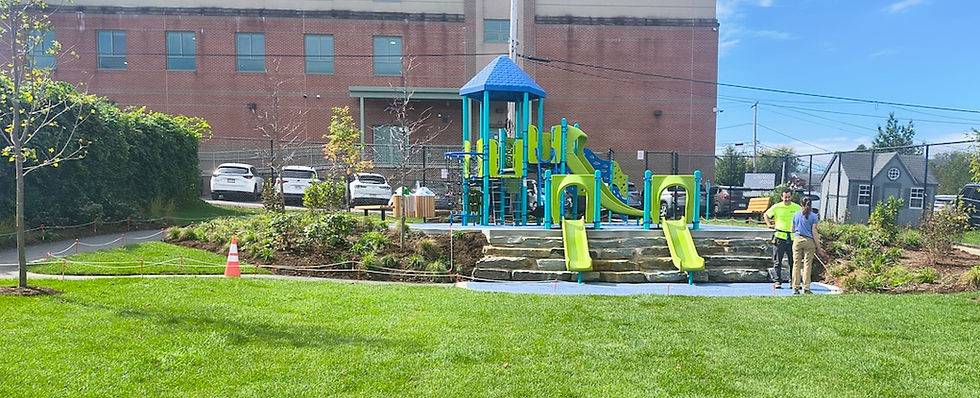
As Valley In Motion prepares for the opening of the Whittier Elementary Community Schoolyard in Scranton, I spoke with Suzanne Flannery Quinn, PhD, of play equipment manufacturer KOMPAN. Dr. Quinn is the manager of the KOMPAN Play Institute, Americas, where she conducts research on child development with a focus on how children and families use playgrounds. Dr. Quinn has a background in research and teaching at universities in the US and the UK, and is the author of a catalogue of peer reviewed empirical research and theory in human development.
Gus Fahey: Growing up in Scranton, PA, school playgrounds were hard asphalt lots with a basketball hoop or two. That was fine for kickball, hopscotch, or tag, skinned knees notwithstanding. It was on these playgrounds that I developed a love for basketball, which I continue to play today.
When I moved back to the area as an adult, I was surprised that Scranton’s kids had none of the play equipment I had seen in other communities. What does updated play equipment provide kids in a community?
Dr. Quinn: Hi, Gus. For children, places to play are essential for all areas of their healthy growth, physically as well as socially. Playgrounds are where children gather with friends, meet new people, and nurture bonds, which is so important to our communities. With updated play equipment, the playground becomes more attractive for children to stay and play in those spaces, and parents and caregivers also become more comfortable with their children spending time there.
If the equipment is well designed, it will help children learn how to move their bodies in ways that they cannot do otherwise. Intentionally designed playground equipment supports muscle strength and maintenance, motor skills of agility, balance, coordination, and provides opportunities to build bone density in addition to promoting aerobic activities. When children can play together with other children of a range of abilities, they learn and practice social and emotional skills.
When children have interesting play opportunities they use language, make decisions, experience cause and effect, which supports cognitive development. And when children are given the permission, time, and freedom to play outdoors in an environment designed to keep them safe, they nourish their creativity and imagination. All of these are essential for healthy development.
Gus: Does having advanced play equipment suppress imaginative play that kids might otherwise do?
Dr. Quinn: A well-appointed or advanced outdoor play space promotes creative and imaginative play if it is designed well. The key to successful design is to provide choices for the children who use the space and to supply durable equipment that can be used in different ways. Every site is different, but generally, on a well-designed playground, children should have opportunities to climb in different ways, to balance, to spin, to swing, to glide, to run around, to make believe, and to manipulate loose parts such as sand, water, dirt, leaves, pinecones, and any earth materials that are native to the local ecology. With these choices, children can use their imagination in infinite ways.
There is a debate about themed playgrounds compared to more open-ended designs. For example, playgrounds can be designed to have elements like ships, castles, rockets, trains, tractors, animals, small towns, cafes, robots (you can make a playground theme for anything these days). Some adults wonder if the themed structures limit the imaginative play - thinking that once a playground is shaped like a ship, it is always a ship in the child’s minds, and the play will always center around ship play. As a social scientist who studies how children and families play on playgrounds I recognize all of the viewpoints in this conversation as valid, but I have not seen evidence that playground themes stifle imagination nor that non-themed structures support imagination. Both are great if they are designed to support children’s choices, socialization, a wide range of body movements, and are useable by children of a range of abilities.
I would also add additional points to the conversation: yes, a ship might always be a ship, and a rocket might always be a rocket, but the destinations that the children imagine or the roles that they take on the ship or rocket will be supported by the imagination that they bring to the play. Themes are often great play starters, especially on public playgrounds, where children may not know each other, for younger children (under age 5) who are developing their communication and play skills, and for children who may have disabilities related to communication. Finally, we do know that themed play structures are very attractive and make people curious to visit a park or playground, especially if a themed structure is visible from afar, and is aligned with local interest, such as the playground at Bledsoe-Miller STEAM Center in Waco Texas, which features a giant rocket and space themed play structures along with swings, spinners, and digital game play. You can see this playground here: https://www.kompan.com/en/us/inspiration/customer-cases/bledsoe-miller-steam-center. Our on-site study of this playground revealed that many families chose to come to the playground because of the space theme.
As part of my work for the KOMPAN Play Institute, I have examined the benefits of dramatic play for children related to themed playgrounds and published a white paper with my colleagues Jeanette Fich Jespersen and Maria Ross Larsen, titled Mastery through Make Believe Play, which can be found here: Benefits of themed play in playgrounds - KOMPAN Play Institute.
Gus: As PTA Treasurer for our neighborhood school, my wife organized a public meeting about securing new play equipment for the school. One of the residents asked, “If we put a playground at this school, isn’t everybody going to want one?” Is there an equality issue we should consider when starting a new playground project at a school?
Dr. Quinn: Of course everybody will want one, and they should! We should advocate for the provision of high quality spaces to play at every school, and in every community. These spaces will help children to have a good life, full of health, happiness, and relationships with neighbors. Playgrounds are where strangers can become friends. We all need friends.
Gus: We do! In my neighborhood, the school playground is now locked after school hours. How does that have an impact on childhood development in a community?
Dr. Quinn: Often the issue with school playgrounds being closed to the public is a matter of supervision, liability, and maintenance.
I’m seeing some communities develop joint agreements between school districts and community parks departments to keep school playgrounds open after school hours so that the community can benefit from the space. This is a fantastic idea that gives children more options to play in a safe and familiar environment.
Some schools might resist leaving their playground open after hours due to concerns over misuse of the playground or possible vandalism by older children in the community. However, if these are problems in the community, it strengthens the argument for the need for more places to play, especially for young adolescents and teens – places that are suited to their need for activity and being with friends.
Gus: I was one of those kids! One of my basketball friends lived across the street from the school. One day, his father called him back to his porch. When he returned, he told me “My Dad says to stop screaming the F word.” The one brain cell kicking around my teenage head didn’t realize the whole neighborhood heard my rants when I missed a shot. I’m glad the playground wasn’t shut off from kids like me while our minds were still developing.
Dr. Quinn: Exactly. In my opinion, adolescents are the most underserved group with regard to outdoor play amenities in communities. We need more play spaces for these children.
Gus: It seems like our schools are underutilized public spaces. They could be performing much better for the health and wellness of our community, especially the social and cognitive development of our kids. Are there any case studies of places that made a real difference in community life through better playgrounds?
Dr. Quinn: Absolutely. There is a program supported by the Texas Trees Foundation, called The Cool Schools Campuses Program. It addresses the urban heat island effect by greening school grounds, increasing the tree canopy and creating outdoor play and learning spaces. The Cool Schools Campuses program has the goal to lower school campus outdoor temperatures and reduce the cost of cooling schools by planting 80 to 100 trees per campus. It enriches these environments with permanent outdoor infrastructure (playgrounds, outdoor classrooms, and trails) and reduces urban ‘park deserts’ by turning asphalt patches into vibrant community playgrounds on school campuses that are open to community use after hours. They focus on serving residents in communities that lack a municipal park within a 10-minute walk.
I had the chance to visit one of the Cool Schools last week in Dallas, and it is truly inspirational! We have worked in partnership with them and Studio Outside to design play innovations that support hands on, active nature play and we see this as providing numerous benefits for children and communities.
You can read more about their work here: https://texastrees.org/cool-schools/
And Studio Outside here: https://www.studiooutside.us/cool-schools-neighborhood-parks-community-engagement.
Gus: What great inspiration! I see that Trust for Public Land is a partner in that effort. TPL is our essential partner for Community Schoolyards in Scranton as well. At this point, four of our elementary schools now have play equipment, and we’re raising money for a fifth next year. After that, we’ll have five more to go. Any final words of encouragement?
Dr. Quinn: I would say, stay strong. What you are doing is important. Playgrounds are an investment in health and wellbeing for children, their families, and the whole community. Playgrounds are civic architecture, more than just swings and slides, they are a community commons, a place we share for the common good.
Great playgrounds will also attract people to want to live in your city, and even to visit for recreation. Many communities that are trying to develop forward thinking strategies begin with the parks and play amenities that they carefully design to reflect local histories, culture and spirit. In doing so, they improve the quality of life for residents and attract visitors, businesses, and new residents.
Gus: Terrific, that's great motivation to keep going. Thank you, Dr. Quinn! We appreciate your time to speak with us!
Dr. Quinn: Thank you. I am inspired by what you and your partners are doing in Scranton. Scranton is a lovely and charming city that I have been to several times, and have very much enjoyed my time there. I am a Syracuse University Alum, and spent my childhood in Pittsburgh. There’s something familiar and friendly that is apparent in your city, and I’m sure it will be enriched by your efforts and bringing more play to the community for generations to come.


Comments